

BioShield®
Biocontrol for safe, effective grass grub control
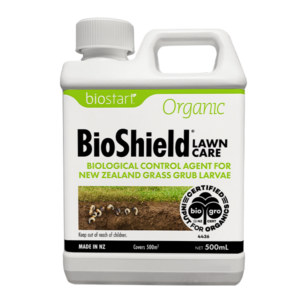
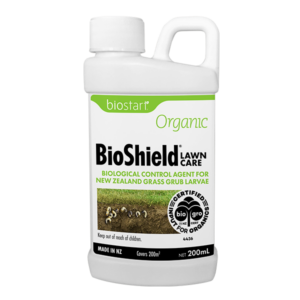
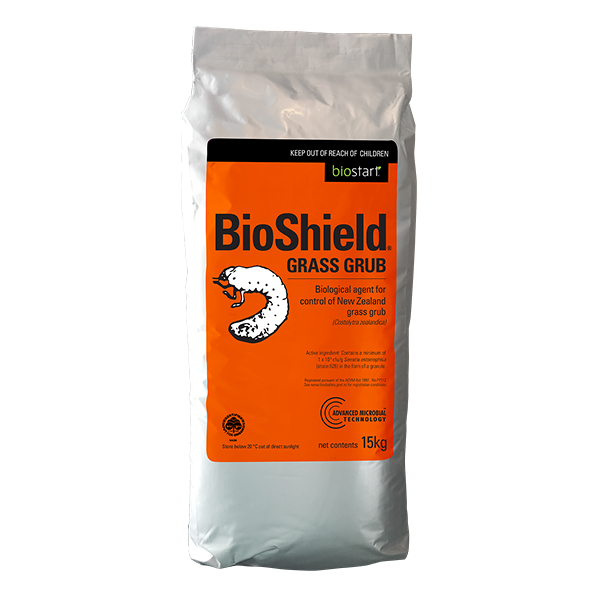
Buy now
For our 1L and 5L sized containers, large orders and volume discount pricing email us here, call 0800 116 229, or visit one of our retailers.
Our 15 kg bags of granules are only available at retail stores.
Grass grub larvae feeding on plant roots can cause significant damage to pastures, cereal and forage crops.
BioShield Grass Grub Liquid and Granules are a long-term grass grub control solution that works by introducing a disease that is specific to grass grub larvae, which is then passed from dead grubs to other larvae.
Grass grub control timeline:
- Six weeks – approx. 10–20% of grass grub show signs of amber disease (specific for NZ grass grub larvae only).
- One year – the grass grub larvae population should be approximately halved from time of application. Dead grass grub larvae will not be visible as they decay quickly.
- BioShield Grass Grub provides protection for approximately 2–3 years, depending on environmental conditions.
BioShield Grass Grub contains the active ingredient Serratia entomophila, a soil bacterium that occurs naturally in New Zealand which causes amber disease in grass grub (Costelytra giveni).
BioShield Grass Grub starts the amber disease cycle in NZ grass grub larvae leading to population decline:
- BioShield is applied to the soil and is ingested by grass grub larvae, which take in the soil while feeding on plants and roots.
- Once inside the grass grub gut, the Serratia entomophila bacteria multiply and cause amber disease. As a result, within three days, the grass grub stops eating.
- When the infected grass grub dies of starvation and decomposes, the Serratia entomophila bacteria in their gut is released into the soil and ingested by other grass grubs.
- The cycle of infection is now set up for long-term control of the grass grub.
BioShield Grass Grub is safe for humans, stock and other insects.
BioShield Grass Grub liquid is a Registered pursuant of the ACVM Act 1997 No. P4409.
BioShield Grass Grub granules is a Registered pursuant of the ACVM Act 1997 No. P7112.
Directions for use:
Check out our grass grub vineyard control brochure and our brochure for using BioShield granules on pasture and turf.
| Product | Timing | Application |
|---|---|---|
| Home lawn care | ||
BioShield Lawn Care |
February to May | Dilute 10mL of BioShield® Lawn Care in 1 L of clean water. Use a knapsack sprayer in the late afternoon to recently mown lawn. 1 L of mixture covers 10 m² of lawn. After application water the lawn for 15 mins. |
| Pasture and turf | ||
BioShield Liquid |
February to May | Dilute BioShield® in 100 L/ha of unchlorinated, clean water prior to application. Apply BioShield® at 1 L/ha via a liquid applicator fitted to a seed drill (e.g. triple disc or direct drill) to a depth of 10–30mm below soil surface, to actively feeding grass grub larvae. |
| Pasture (grass/plantain/clover mixed swards) | ||
BioShield Granules |
February to May | Broadcast 30 kg/ha of BioShield Grass Grub on to pasture (grass/plantain/clover mixed swards) when the second and third instar grass grub larvae are actively feeding. |
Maximising the activity of BioShield®
- Soil moisture content must be above 15–20% before applying BioShield® on to soil. Irrigate after application if required.
Post-treatment management – Do not use:
- Alternative grass grub control practices such as heavy rolling or insecticide treatments after application as this will reduce the effectiveness of BioShield® Grass Grub.
- Cultivation following treatment as it is likely to reduce the effectiveness of BioShield® Grass Grub.
- Mob stocking of the treated paddock within the first six weeks after application of BioShield® Grass Grub to ensure the Serratia entomophila become established in the grass grub population, so setting up the long-term cycle of control.
It is an offence to use this product on animals.
BioShield® must not be applied directly on to or into water.
Withholding period: Nil
Compatibility: Call Biostart 0800 116 229 for a compatibility list.
Material Safety Data Sheet
Download the liquid material safety data sheet or the granules material safety data sheet.
Label information
Download the BioShield Grass Grub Liquid label, our BioShield Lawn Care product label, or our BioShield Grass Grub Granules label.
Handling precautions
Avoid skin contact and inhalation of spray mist. Wash hands and exposed skin before meals and after work. Store in the original packaging, tightly-closed away from children. Do not store diluted product.
It is an offence to use this product on animals.
BioShield®Grass Grub Liquid must not be applied directly on to or into water.
Storage instructions
Store under refrigeration (4 °C) at all times prior to application. Exposure to sunlight or warm temperatures will reduce viability. Keep out of each of children.
Empty container disposal
Triple rinse and return to an approved AgRecovery recycling centre.

Label information
Download the BioShield Grass Grub Liquid label, our BioShield Lawn Care product label, or our BioShield Grass Grub Granules label.
Empty container disposal
Triple rinse and return to an approved AgRecovery recycling centre.